Hindi, English or Hinglish
Why the language your company works in is the wrong input, what the census actually says, and the twenty-person test that settles it.
C4E Talent · published 19 August 2026 · 9 min read
For most Indian corporate rooms the answer is Hinglish, because it is the only register that reaches both the people who think in English and the people who think in Hindi. Do not choose the language your company writes emails in. Census 2011 recorded English proficiency at about 10.6% of Indians against 57% for Hindi, and your plant, field and support teams sit on the wrong side of that gap. Book a comedian who can switch mid-set, and say so in the brief.
The short version
- Hinglish is the default for any room drawn from more than one city or more than one function.
- Census 2011 put English proficiency at roughly 10.6% of the population and Hindi at about 57%. Your office is not a representative sample, and your plant is closer to one.
- A joke understood a beat late is not a joke. Comprehension delay is what kills a mixed-language room, not incomprehension.
- Ask twenty people to name their favourite comedian. The language of their answers is the language of your show.
- Regional-language rooms deserve regional-language comedians. A Hindi set in a Chennai plant is a tax, not a treat.
- Comedians who genuinely switch languages mid-set are rare. Parijat Sarkar works in Hindi, English, Gujarati and Bengali.
Every event team asks the same question in the same words: should the set be in English or Hindi? It is the wrong question, asked by the wrong person, using the wrong evidence. The right question is what language the room laughs in, and the answer is almost never the language the room works in.
Why your instinct is wrong
The person choosing the entertainment usually sits in a head office, works in English, writes in English, and is surrounded by people who do the same. From that desk, English is obviously the safe choice. It is the language of the deck, the all-hands and the appraisal form.
But an annual day is not a head-office meeting. It is the one evening a year when the plant supervisor from Aurangabad, the regional sales team from Indore, the support centre in Coimbatore and the product team from Bengaluru are all in one room. Those groups do not share a working language in any real sense. They share a functional one for slides and a completely different one for jokes.
| Language | Share of the population | What that means for your room |
|---|---|---|
| Hindi | About 43.6% as mother tongue, about 57% including second and third language | The largest single common denominator in a pan-India room, but not a universal one. |
| English | About 10.6% proficiency, and a vanishingly small share as a mother tongue | Over-represented in head offices and boardrooms, under-represented everywhere your revenue is actually made. |
| Bengali, Marathi, Telugu, Tamil | Each between roughly 5% and 8% as mother tongue | In a single-site room in Kolkata, Pune, Hyderabad or Chennai, the regional language beats both of the above. |
What Hinglish actually is
Not English with Hindi words dropped in for flavour, and not Hindi with English nouns. Hinglish is the register most urban Indian workplaces genuinely speak: the sentence structure moves between the two languages, the setup might be in one and the punchline in the other, and the switch itself carries meaning. Saying something in Hindi that everyone expected in English is, on its own, funny.
That is why it works so well on stage. A comedian in Hinglish can land the same joke twice, once in each register, and can pick whichever half of the sentence carries the surprise better. It also means nobody in the room is ever more than a few seconds from something in their own language, so the delay problem never gets a chance to start.
It is a real skill and not every comedian has it. Plenty of excellent English comics become stiff the moment they switch, and plenty of Hindi comics lose their rhythm in English. Watch a full set and listen for whether the switching sounds like the way people talk or like a translation happening live.
Four rooms, four answers
One city, one function, urban
A product team in Bengaluru, a consulting office in Gurgaon, an agency in Mumbai. English or Hinglish both work. Pick by the comedian, not the language. If the room skews under 30 and is mostly engineers, English is entirely safe.
Mixed, drawn from across the country
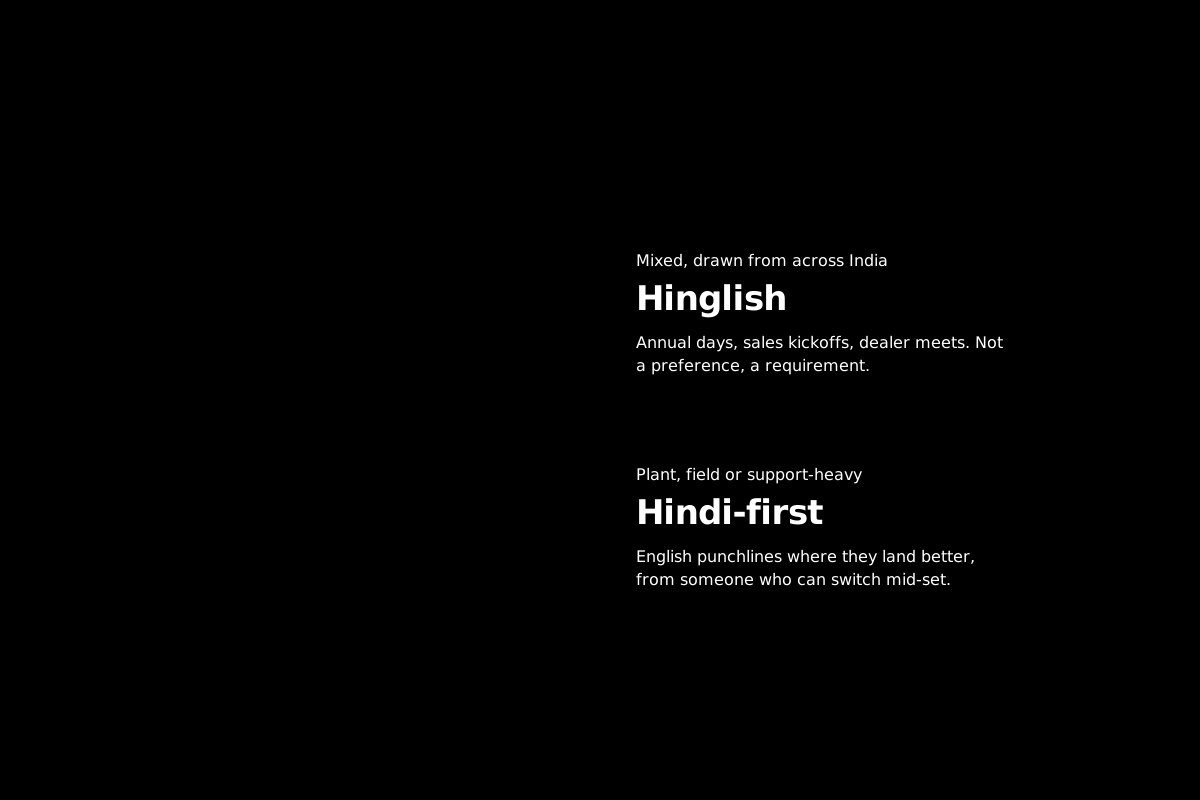
Annual days, sales kickoffs, dealer meets. Hinglish, and it is not really a choice. This is the room where an English set leaves a quarter of the audience watching the others enjoy themselves, which is a worse outcome than a slightly less polished set that everyone gets.
Leadership only
Twenty to sixty senior people, usually at an offsite. English is generally safe here, and a set in English can go further intellectually because the shared reference set is wider. Ask anyway: a leadership team drawn from a manufacturing business often skews far more Hindi-comfortable than the same size team at a software company.
Plant, field or support-heavy
Hindi-first, with English punchlines where they land better, delivered by someone who can read which way the room is leaning and adjust in real time. This is the room where language choice does the most damage when it is wrong, and where the head office's instinct is most reliably mistaken. It is also the room that appreciates being got right the most, because it is the one that usually is not.
The twenty-person test
You do not need a survey. Ask twenty people from across the invited group, in different functions and different cities, to name their favourite comedian. Not their favourite comedy. A named person.
The language those twenty comedians perform in is the language of your show. The test works because it measures what people choose to watch on their own time, in their own home, with nobody from HR listening, which is a far better predictor than anything they will tell you about their English.
Regional rooms deserve regional comedians
If your audience is a single-site team in Kolkata, Chennai, Hyderabad, Ahmedabad or Kochi, the best show available to you is in their language, performed by someone from that circuit. A Hindi set in a Chennai plant is not a compromise, it is a small imposition, and the room registers it as one within the first two minutes.
The regional comedy circuits in India are deeper than most head offices realise. Gujarati, Bengali, Marathi, Tamil, Telugu and Kannada all have working professional comedians with corporate experience. Booking one is usually cheaper than flying a national name in, and it lands better. That is a rare combination and worth taking.
What to write in the brief
Two lines in the nine-line brief do this job.
Language: Hinglish. Roughly 60% of the room is comfortable in either. About 15% are genuinely more comfortable in Hindi and they are mostly the Indore and Aurangabad teams, seated on the left. Around 10% are Marathi-first. Nobody needs an English-only set.
Notice the seating detail. A comedian who knows where the Hindi-comfortable third of the room is sitting can play to that side of the room deliberately, and can watch it for the early signal that the register is wrong. That is a five-word addition to a brief that changes how the first ten minutes are performed.
Two mistakes worth naming
- Booking two comedians, one per language. It sounds inclusive and it splits the room in half, twice. Each half sits politely through the other's set. One performer covering both registers is better in every respect, including cost.
- Asking for a Hindi set from an English comedian at short notice. Language is not a setting. Material written in one language has to be rebuilt in the other, and rebuilt material is a month of work, not a favour you ask for on Wednesday.
Where we sit on this
Parijat Sarkar performs in Hindi, English, Gujarati and Bengali, and most corporate sets go out in Hinglish because that is what most of these rooms are. He describes himself as a Bengali who loves debates and a Gujarati who loves rebates, which is both the act and a fair summary of why the switching sounds natural rather than performed.
Four working languages in one performer is unusual on the Indian circuit. It matters most for the room this guide keeps coming back to: the mixed national audience where an English-only set costs you a quarter of the laughs and nobody afterwards can quite say why the evening felt flat.
Tell us the cities your audience is flying in from and we will tell you which register to book. Send the room details →
Questions buyers actually ask
- Should a corporate comedy set in India be in Hindi or English?
- For most rooms, neither on its own: Hinglish. It is the only register that reaches both the people who think in English and the people who think in Hindi, and the switching itself is a source of comedy. Reserve English-only for single-city urban teams or leadership-only rooms, and Hindi-first for plant, field and support-heavy audiences.
- What percentage of Indians speak English?
- Census 2011, still the most recent published language data, recorded English proficiency at roughly 10.6% of the population, against about 57% for Hindi including second and third languages. Head offices are heavily unrepresentative of that, which is exactly why the head office's language instinct is usually wrong for an all-company event.
- How do we work out which language our audience wants?
- Ask twenty people from across the invited group to name their favourite comedian, not their favourite comedy. The language those performers work in is the language of your show. It measures what people choose to watch on their own time, which predicts far better than anything they will say about their English.
- Is it a good idea to book two comedians, one per language?
- No. It splits the room in half twice, with each half sitting politely through the other's set. One performer who can move between registers holds the whole room and costs less than two artists.
- Can a comedian switch language for our event at short notice?
- Not really. Material written in one language has to be rebuilt in the other, not translated, and rebuilding is weeks of work. Book someone who already performs in the register you need, and confirm it by watching a full set in that language.
- Should a single-site team in Chennai or Kolkata get a regional-language show?
- Usually yes. The Tamil, Bengali, Marathi, Gujarati, Telugu and Kannada circuits all have working professionals with corporate experience, and booking locally is often cheaper than flying a national name in. A Hindi set in a Chennai plant reads as a small imposition, and the room registers it in the first two minutes.
- What happens if we get the language wrong?
- Not confusion, delay. People with functional English understand the joke half a second late, so the laugh lands after the comedian has moved on, the room hears itself laughing out of time and quietly stops. Nobody afterwards will tell you they did not understand; they will just say the evening felt flat.
Book the show, not the guesswork
C4E Talent represents Parijat Sarkar, a Mumbai stand-up comedian and host who spent eleven years inside corporate India before he started selling the jokes instead of living them. Clean by default, up to 15% of every set written for the client, rates published on the page.